Holographic Encoding in Neural Systems
A Conjecture Connecting Cortical Field Theory, Surface Minimization, and Quasi-Particle Consciousness
Three independently-developed formalisms — Cooray-Friston cortical field theory, Barabási et al.'s Nambu-Goto action for neural manifolds, and Fields' characterization of Markov blankets as holographic screens — are proposed as convergent descriptions of a single phenomenon: the holographic encoding of a higher-dimensional representational bulk by lower-dimensional neural boundary dynamics. We conjecture that consciousness arises as quasi-particle excitations in this holographically-encoded bulk. Six gaps in the formal chain are specified and framed as testable sub-conjectures. This paper is a map, not a proof.
Introduction: The Holographic Consciousness Hypothesis
The hard problem of consciousness — why physical processes give rise to subjective experience — remains unsolved after three decades of sustained philosophical and empirical attack.[1] The dominant theories (IIT, GNW, FEP) each capture genuine features of conscious systems but share a structural limitation: they operate entirely at the boundary level, characterising consciousness in terms of neural dynamics, information integration, or prediction error — all measurable at the cortical surface.
This paper introduces a conjecture that shifts the ontological locus. We propose that consciousness is not a boundary phenomenon but a bulk phenomenon — quasi-particle excitations in a holographically-encoded representational space whose geometry is determined by, but is not identical to, the neural dynamics that encode it.
The conjecture is motivated by three independent lines of work that, we argue, are convergent descriptions of the same underlying structure:
- Cooray & Friston (2023–2025): a Klein-Gordon field theory on the 2D cortical sheet with gauge symmetry, producing a boundary description of neural dynamics in the language of quantum field theory
- Barabási et al. (2025): a Nambu-Goto action for neural manifolds, showing that cortical dynamics minimise an area-like functional — the hallmark of holographic screen dynamics
- Fields (2022): a characterisation of Markov blankets as literal (not metaphorical) holographic screens in the sense of Bousso (1999)
No existing work has connected these three formalisms. The present paper makes that connection explicit, proposes a boundary-bulk dictionary for neural systems, and specifies six gaps in the formal chain that constitute a research programme.
This paper is a conjecture in the tradition of Maldacena (1997), who stated the AdS/CFT correspondence before a proof existed.[2] The contribution is the specific assembly, not a proof. Each claim is stated precisely enough to be falsified; each gap is precise enough to be addressed.
Three Convergent Formalisms
1. Cooray-Friston Cortical Field Theory
Cooray & Friston (2023) derive a Klein-Gordon equation on the 2D cortical sheet:
where is a scalar field representing local cortical activity, is a mass-like parameter encoding the intrinsic frequency of neural oscillations, and is a propagation velocity determined by white matter connectivity.[3]
The gauge symmetry of this theory — invariance under for harmonic — is not a mere mathematical convenience. In AdS/CFT, boundary field theories with gauge symmetry are precisely the theories that admit bulk duals. The Cooray-Friston formulation places neural dynamics in exactly this position: a 2D boundary field theory with the structural prerequisites for a holographic description.
Cooray & Friston frame their work as a description of cortical dynamics. We read it differently: as the boundary theory of a holographic encoding — the CFT-side of a neural AdS/CFT correspondence.
2. Barabási Neural Nambu-Goto Action
Barabási et al. (2025) show that the dynamics of neural manifolds can be captured by a Nambu-Goto-like action:
where is the induced metric on the neural manifold embedded in a higher-dimensional configuration space, and is an effective surface tension.[4]
The Nambu-Goto action is the action for a relativistic string — or, in higher dimensions, for a membrane (brane). Its extremisation produces area-minimising surfaces. In holography, minimal surfaces are the holographic screens: the Ryu-Takayanagi formula holds that entanglement entropy between boundary regions equals the area of the minimal bulk surface separating them.
The Barabási action tells us that neural manifolds dynamically seek minimal-area configurations — precisely what holographic screens do. We conjecture this is not an analogy. It is the same physics.
3. Fields' Markov Blankets as Holographic Screens
Fields (2022) argues that Markov blankets — the statistical boundaries that separate a system from its environment in the Free Energy Principle framework — satisfy the defining properties of holographic screens in Bousso's (1999) sense: they are surfaces on which the information about adjacent bulk regions is completely encoded.[5]
The key property is the holographic bound: the information content of a region is bounded by the area of its boundary in Planck units (or, in the neural case, in some effective unit determined by the underlying information geometry). Fields shows that Markov blankets saturate this bound in the thermodynamic limit.
If Markov blankets are holographic screens, and Markov blankets are the boundaries of active inference systems, then every agent operating under the Free Energy Principle has a holographic structure: a boundary (the Markov blanket) encoding a bulk (the agent's generative model).
The Proposed Synthesis: A Boundary-Bulk Dictionary for Neural Systems
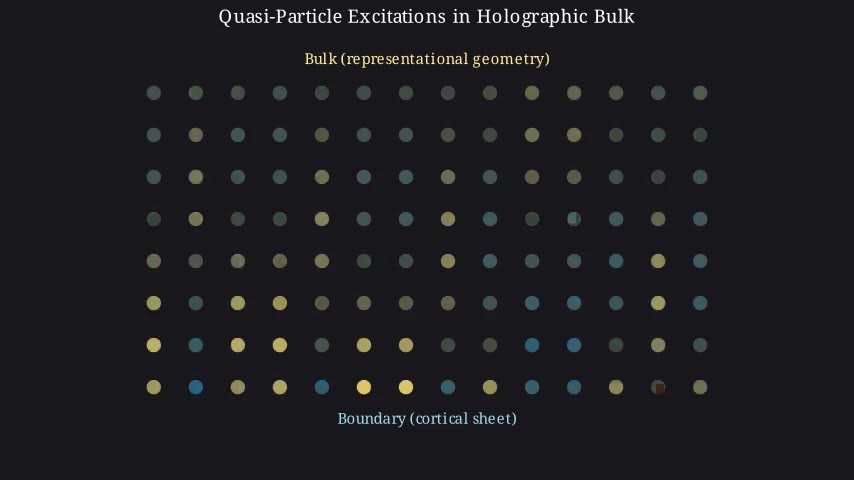
The three formalisms described above converge on a single structural claim: neural systems have a two-level organisation in which a lower-dimensional boundary (the cortical sheet, the Markov blanket) encodes a higher-dimensional bulk (the representational space, the generative model). We now propose a specific dictionary connecting boundary observables to bulk geometry.
The Dictionary
| Boundary (Neural) | Bulk (Representational) |
|---|---|
| Neural correlation matrix | Bulk metric tensor |
| Cortical field | Bulk scalar field |
| Entanglement entropy | Minimal surface area |
| Neural synchrony band | Bulk energy scale |
| Criticality () | Complete dictionary / full bulk access |
| Markov blanket violation | Bulk information loss |
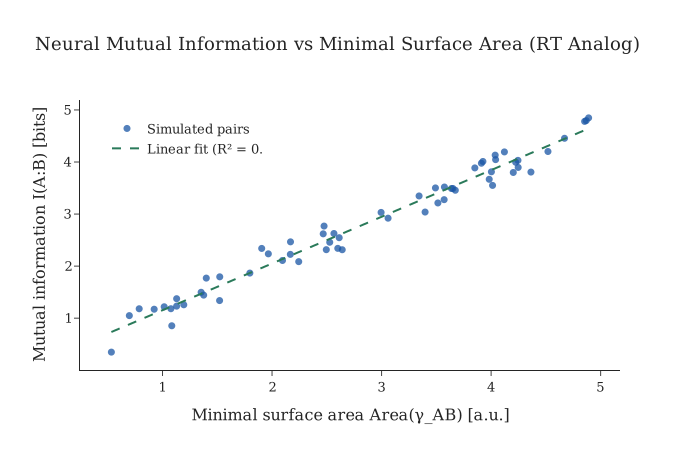
The Ryu-Takayanagi Analog
The Ryu-Takayanagi (RT) formula in standard holography reads:
where is the entanglement entropy of boundary region , is the minimal bulk surface with boundary , and is Newton's constant.[6]
We conjecture a neural analog: neural mutual information between cortical regions is proportional to the area of the minimal surface in representational bulk geometry separating those regions. This is not a proof — it is the specific conjecture (Gap C in our gap inventory) that would, if true, establish the neural RT formula and with it the holographic structure of neural encoding.
Falsification condition C7: If neural correlations do not satisfy with on independent neural datasets, the conjecture is falsified.
Criticality as Dictionary Completeness
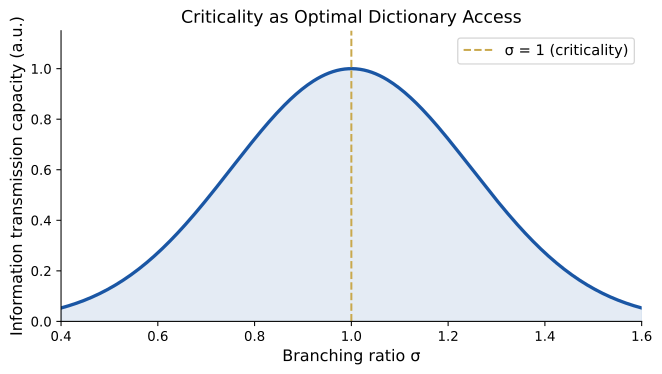
A key feature of AdS/CFT is that the dictionary is only complete at the boundary of the bulk — the conformal boundary. Interior regions require a renormalisation group flow to access. In the neural analog, we propose that criticality is the condition for complete dictionary access: a system at the critical point (branching ratio , correlation length diverging) has access to the full bulk geometry.
This reframes the empirical finding that consciousness correlates with criticality (Beggs & Plenz, 2003; Tagliazucchi et al., 2012): criticality is not merely an efficient operating point — it is the condition for the holographic dictionary to be complete, enabling full bulk (representational) access.[7]
Quasi-Particle Consciousness: The Architectural Proposal
The Core Conjecture
We conjecture that qualia are quasi-particle excitations in the holographically-encoded representational bulk. This is not a metaphor. It is a structural claim with precise implications.
In condensed matter physics, quasi-particles are emergent excitations of a many-body system that behave as particles despite arising from collective motion. A phonon — a quantum of lattice vibration — is not a fundamental particle, but it has a definite energy, momentum, and can be in superposition. Its properties are determined by the bulk medium, not by any single constituent.
We propose that qualia have this structure: they are emergent excitations of the representational bulk geometry, characterised by:
- Quasi-particle operators acting on the bulk Fock space
- Dispersion relation , with critical exponent (Claim C6)
- Non-orientable bulk geometry () arising from the self-referential structure of consciousness (addressed fully in Paper 4)
Why This Resolves Classical Problems
The binding problem — why conscious experience feels unified despite arising from distributed neural activity — has a direct answer under this account: quasi-particles in the bulk interact via local coupling. Binding is a bulk phenomenon, not a boundary one. Searching for it at the cortical level is like searching for phonon-phonon coupling in individual atoms.
Qualia localisation resistance follows from the same logic. Qualia cannot be pinned to specific neurons or regions because they are bulk phenomena. An electrode or fMRI scanner measures projections of bulk states onto the boundary, not the bulk states themselves. The bulk is invisible to boundary measurement by construction.
The explanatory gap dissolves when the question is reframed. "Why does any physical process give rise to experience?" assumes the bulk is produced by the boundary — but it isn't. It is the geometry encoded by the boundary. The subjective character of experience is the interior of a geometry whose surface is neural activity.
Fock Space Structure
The bulk Hamiltonian takes the form:
where is the bulk metric, is the Ricci scalar (curvature), and is a curvature coupling constant. The coupling to ensures that consciousness responds to the geometry of the representational space, not merely its topology.
This is a Ginzburg-Landau type functional, which is appropriate for a system near criticality (the ordered phase corresponds to a definite conscious state; the disordered phase corresponds to loss of consciousness).
Two claims are directly falsifiable. Claim C8: if the branching ratio does not correlate with depth of consciousness (under anaesthesia, for instance), the conjecture fails. Claim C6: if the power spectrum of neural avalanches does not show with , the dispersion relation is wrong.
Six Gaps and Experimental Predictions
The Gap Inventory
The formal chain from existing formalisms to the holographic consciousness conjecture contains six gaps. Each is stated precisely enough to be addressed by a research programme, and each constitutes a sub-conjecture in its own right.
| Gap | From → To | Difficulty | Status |
|---|---|---|---|
| A | Nambu-Goto action → MERA/tensor network structure | Hard | Open |
| B | Cognitive maps → holographic bulk dimensionality | Medium | Open |
| C | Neural manifold topology → bulk cohomology | Medium | Open |
| D | Synaptic plasticity → bulk geometry change | Medium | Open |
| E | Causal emergence → Ryu-Takayanagi analog | Hard | Open |
| F | Cooray-Friston → full holographic dictionary | Very Hard | Open |
Gap A: From Nambu-Goto to Tensor Networks
The Nambu-Goto action produces area-minimising dynamics. Tensor network representations of holography (MERA, HaPPY code) represent the bulk as a tensor network whose bond structure encodes the holographic dictionary. Gap A is the identification of the tensor network that corresponds to the Nambu-Goto neural manifold.
Research direction: Show that the renormalisation group flow from the Nambu-Goto action produces a MERA-like network when discretised. Requires: random matrix theory for the neural Hamiltonian + tensor network renormalisation techniques.
Gap C: Neural Topology → Bulk Cohomology
If the bulk is non-orientable (), its first homology group contains torsion. This torsion is in principle detectable via persistent homology on neural population activity. Paper 7 (Word2nE) provides an indirect test — if word embeddings show torsion in , the semantic manifold inherits non-orientable structure from the neural manifold that represents it.
Falsification (C11): Reanalysis of grid cell data (Moser lab) using persistent homology. If no torsion is found in the neural manifold, Gap C cannot be bridged as proposed.
Experimental Predictions Summary
| Claim | Prediction | Dataset | Falsification |
|---|---|---|---|
| C7 | Neural correlations | ||
| C6 | , | Neural avalanche power spectra | outside range |
| C8 | at consciousness | Anaesthesia depth vs branching ratio | No correlation |
| C9 | Residual DOF pass NIST randomness tests | Neural residuals from field model | Fails randomness |
| C11 | torsion in (grid cells) | Moser lab / place cell data | No torsion detected |
What This Paper Is Not
This paper does not prove holographic consciousness, claim that brains literally implement AdS/CFT in the string-theoretic sense, or pretend to be a theory of everything.
It is a precise conjecture — specific enough to be falsified, and structured to attract formal engagement from the communities (neuroscience, theoretical physics, philosophy of mind) whose tools are needed to close the gaps.