Distilling the Local Rule: Surface Minimisation as an Emergent Property
Replacing the global Nambu-Goto watcher with a purely local, distilled update rule whose emergent behaviour minimises wiring surface and sits at criticality — and testing whether it is a law (scale-invariant) or a fit
The prototype enforced its geometry: a global watcher solved the surface problem and moved the nodes there, so 'the substrate minimises wiring surface' was true by construction. This paper earns it. We distil a purely local update rule f_theta — each cell reading only its own state and the relative geometry of its immediate neighbours, never the global action or any population statistic — that reproduces surface descent, then run it with the watcher off and measure the result. The discovery machinery (the factory) is strictly offline and is the only place the surface action S appears: behavioural cloning of the watcher's per-node displacement plus a differentiable rollout that backpropagates S through a multi-step geometry rollout. The runtime body (the chassis) carries the frozen theta and no global term; the rule is rotation-equivariant and translation-invariant by construction, built from relative neighbour vectors with no absolute frame, and radius-truncated through a spatial hash, so locality is physical rather than merely intended. Two properties then emerge with no global term at runtime. Surface minimisation: a naive clone oscillates — it descends on barely half its passes — and a decentralised backtracking gate applied in Gauss-Seidel order restores clean monotone descent (99% of passes, surface removed matching the watcher's own). Quasi-criticality: 0001's sub-critical reading was an artifact of a constant DC drive, and once the operating point is calibrated the watcher-free chassis sits at branching ratio ~0.9 — but this is a tuned operating point, not self-organised criticality (a later sweep of dynamic depressing synapses found no parameter-free regime). The realistic reading of the topology is a cost-pole one: at scale the rule's grown geometry does read more critical than a frozen lattice (0.87 vs 0.75), but the causal chain 'wiring economy grows a small-world that drives criticality' is confounded — a static-lattice rewire is already small-world, and a degree-matched random graph reaches the same branching ratio — so surface minimisation is a cost prior here, not the generator. The holographic precondition, retested on a clean toroidal boundary with a controls-validated mutual-information estimator (the dimensionality-robust ones fail a known-volume-law control), reads volume-law — the expected thermal default of an idle quasi-critical net — which relocates the live area-law question to the dynamical phase under an encoding/FEP task. The same chassis, scaled and ported to async event-driven execution, becomes v0.2. A second pass then audits not whether the structure descends but how it moves, and finds the inherited teacher remodels like a seizure — add-only, global, on the activity timescale (32 edges per pass, zero pruning, a 25-tick cadence inside the 11-tick avalanche band), violating the slow-drive/fast-relaxation axiom of self-organised criticality. We retime it per-neuron (lognormal periods — desynchronisation, not mere slowing) and make it activity-gated and balanced (a local calcium-coincidence set-point with formation/elimination turnover and tag-and-capture consolidation), then re-distil that teacher, so the local rule inherits breathing rather than seizing structure. The fix exposes that structure and function are one controller (postsynaptic calcium to CaMKII) with two readouts — the volatile synaptic weight and the durable wiring — and it earns a result: a causal double dissociation in which the connectivity layout alone decodes a past stimulus, the decode following the gate rather than the operating point (invariant across a 3.3x branching-ratio sweep; an ablated network at higher criticality still cannot decode), with the gated memory-bearing structure reaching the in-vivo reverberating regime at scale. The layout is the memory.
Introduction
0001 left a circularity we could not talk our way out of. Its watcher solved the surface problem globally — it computed the gradient of the wiring action over the whole network and moved every free node to where that gradient pointed — so the statement "the substrate minimises its wiring surface" was true by construction. Nothing emerged; a solver imposed an answer.
Meng et al. (2026) give the license to fix it: surface optimisation is a local design principle of physical networks, not a global computation bolted on top.[1] If that is right, there should exist a purely local update rule whose emergent collective behaviour is the minimisation — no node ever seeing the global action.
This paper earns that. We distil a local rule from the watcher, freeze it, run it with the watcher off, and then interrogate the result rather than the construction, along two axes:
- Does the wiring surface still descend when the only thing moving nodes is a rule that reads its own neighbourhood? Surface minimisation as a result, not a guarantee.
- And — the part 0001 reported as an honest negative — does the same watcher-free substrate sit at criticality? 0001 measured , sub-critical. That turned out to be an operating-point artifact of a constant DC drive, not a property of the substrate; once the drive is calibrated the chassis reaches — a tuned operating point, not self-organised criticality. At scale the rule's geometry does read more critical than a frozen lattice, but the controls show that differentiation is confounded — the small-world comes from the proximity rewire, not the surface objective — so wiring economy is a cost prior here, not the generator of criticality.
The rest of the paper is how we got there, and where it honestly lands: the quarantine that keeps it clean, the rule's form, what broke during distillation, the two fixes — one for the geometry, one for the dynamics — that make both properties emerge (while the controls separate what NG causes from what merely co-occurs), and the holography feasibility gate, which closes as volume-law on the idle substrate and hands the area-law question to a later encoding/FEP phase.
Factory vs chassis
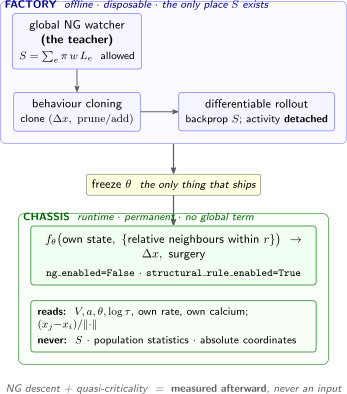
The whole result hinges on one discipline: the global action is allowed to exist in exactly one place, and that place is thrown away.
The factory is the offline distillation loop — the teacher (the watcher), the student , the cloning objective, the differentiable rollout. It is the only code that ever computes or runs the watcher. It produces and is then discarded.
The chassis is what survives to runtime: the local-rule socket, the
spatial-hash neighbourhood that makes locality physical, the
structural_rule_enabled swap that drops in where the watcher was, and
the geometry-only run mode for scaling. It carries the frozen and no global
term. This is what 0003 ports to async.
If ever leaked into the chassis, "emergent minimisation" would collapse back into 0001's circularity. So the firewall is absolute: NG offline only, criticality measured post-hoc, no population statistic read at runtime.
One subtlety we had to get right. Reaching criticality needs an operating point — drive strength, E/I ratio, homeostatic timescales — and we tune it with an Optuna study. That study varies substrate hyperparameters only; the geometry, the seed set, and the criterion ( and its target) are held fixed. Tuning the substrate toward a fixed criterion is honest; tuning the criterion toward the substrate would not be. And because the study calibrates the teacher's own criticality, the distilled chassis inherits a near-critical operating point rather than being driven to one — the operating point lives in the substrate config, never in .
The local rule
The rule has to compute a node's move while being structurally incapable of reading anything global. We get that from its form.
takes a node's own state plus its neighbours and returns a displacement
and per-neighbour prune/add logits — the same call pattern as the synaptic
local_update. The neighbourhood is radius-truncated through a spatial hash (a cell
list), , so a node cannot reach beyond its immediate neighbours even
in principle. And the inputs are relative: neighbour vectors
, distances, an is-edge flag — never an absolute
coordinate, so there is no global frame for a signal to ride in on.[2]
The displacement itself is
a sum of unit neighbour-directions with learned coefficients. It is translation-invariant and rotation-equivariant by construction, permutation-invariant because it is a sum, and — crucially — the same shape as the watcher's own descent, whose coefficient is . That shared shape is what makes the watcher a cloneable teacher. The action being descended, , is the uniform-cylinder lower bound of Meng et al.'s full surface functional: the leanest geometric cost that still carries the surface-tension gradient.
We learned the hard way that a freer rule is worse. A grad-scaled variant — exact descent direction with a learned magnitude, — distils poorly and, with no step cap, expands the geometry far from equilibrium (chassis surface removed ; it inflates the blob). The constrained sum-of-units form, plus the local step gate we describe under Emergence, is what keeps the rule both representable and stable.
Distillation
Teaching has two halves, and the interesting part is what went wrong between them.
Behavioural cloning is the cheap, well-posed half: regress against the watcher's per-node displacement, through the same geometry-only features the chassis will run. It bounds representability, and the cloning loss falls steeply — at side 5 (a roughly 400-fold drop) and at side 8. The student tracks the teacher's displacement closely.
Differentiable rollout is the primary half: backpropagate through a multi-step geometry rollout of . Because depends only on positions and edges, activity is a detached feature — there is no backprop through the spiking loop — and the discrete add/prune is a straight-through refinement.[3] Its surface-reduction fraction improves with training and with teacher size: at side 5, and at side 8 it flips from (the untrained rollout increases surface) to . The bigger teacher — 216 free nodes against 27 — gives far more near-equilibrium signal and a larger gain.
The failure sat between them. Cloning alone overfits the near-equilibrium regime: run autonomously, the cloned rule increases — exactly the covariate-shift risk that no prior result settles, made concrete. The teacher only ever showed the student well-behaved states; off that manifold the student drifts. The fix was to unify factory and chassis on the same geometry-only features, initialise from the clone, then refine with the rollout so the student sees its own trajectory. That turned the chassis from increasing to descending it — but, as the next section shows, not yet cleanly.
Emergence and the leakage audit
This is the section the paper exists for: with the watcher off and only moving nodes, does the surface descend as a result? And does the substrate that does so sit at criticality? Both took a diagnosis and a fix.
The geometry: from oscillation to clean descent
The first watcher-free run was encouraging and broken at once. The frozen rule
removed of surface reading only neighbourhoods — more than the watcher's own
— but only of passes actually descended (frac_descending = 0.525).
It was oscillating: down, up, down.
The cause is sharp. At equilibrium the surface is flat, so the watcher's backtracking line search takes a vanishing step and effectively stops. The cloned MLP does not — it emits a small but nonzero displacement on a flat surface, and roughly half of those go uphill. The clone inherited the teacher's direction but not its step control.
We tried giving the rule explicit step control through magnitude (the grad-scaled variant of the previous section); it overshot far from equilibrium and inflated the geometry. What worked was decentralising the watcher's own trick: a local backtracking gate. Each free node halves its step until its own incident edge-length stops rising — the watcher's backtracking, but reading only the neighbourhood, never the global . Run in Gauss–Seidel order (apply each node's move in place, so a node sees its neighbours' updates), the gate is provably monotone: moving one node touches only its incident edges, so a per-node non-increase is a global non-increase, and the whole pass cannot raise .
The numbers track the fix: frac_descending goes (Jacobi order)
(Gauss–Seidel), with surface removed — essentially the watcher's
— and preserved. Surface minimisation now emerges
cleanly from a rule that never sees the surface. Because the gate is per-node, it is
scale-independent: at side 8 the chassis descends exactly monotonically
(frac_descending , surface removed ), so the emergence holds at scale,
not just at the training size.
The dynamics: criticality was an operating point, not a verdict
0001's honest negative was , sub-critical. Four independent
analyses converged on the cause, then experiment confirmed it: the constant
background drive bg_current = 0.35 pins the membrane near
, about three times threshold. The cell is
then tonically, externally driven; through the Wilting–Priesemann identity
, a large external fraction holds the branching
ratio below one, and the always-on drive erases the slow-load/fast-cascade separation
avalanches require. A pure drive sweep is unambiguous — climbs
as the drive drops , with no code
change. The substrate could always reach criticality (homeostat-off runs hit
); the constant-drive-plus-rate-homeostat pairing was simply
choosing a sub-critical fixed point.
Replacing the DC bias with weak sparse Poisson drive and calibrating the operating point (the Optuna study of Factory vs chassis) lands a quasi-critical teacher at . Frozen into the chassis and run with the watcher off, the local rule holds it: at side 5. Quasi-criticality emerges with no global term at runtime — the second claim, met.
The leakage audit
Emergence is necessary but not sufficient: a rule could descend and still be cheating by reading something global. So we test locality directly, with a falsifiable assertion built for this (no prior art): perturb a node outside cell 's -hop neighbourhood and require 's output for to be unchanged to floating point. If it ever moves, the rule has a global read and the result is void. It does not move — locality is physical, not merely intended.
Structural plasticity: seizure vs breathing
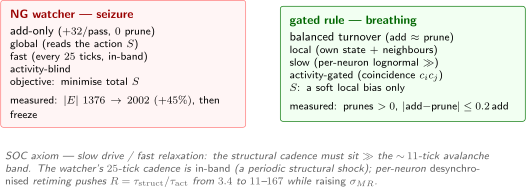
The rule descends the surface and sits near criticality — but how it moves the structure is a separate question, and the honest answer is that the inherited teacher moves it wrong. Real dendritic and synaptic structure is largely stable and remodels slowly; ours created and pruned abruptly. Instrumenting a calibrated side-8 run makes the worry concrete: the watcher adds exactly 32 edges per pass and prunes none — pure monotonic densification, growing (+45%) over the first 33 passes and then hard-freezing. And it fires every 25 ticks, while the mean avalanche lasts ~11 ticks — the structural cadence sits inside the activity band. There is no separation of timescales.[5]
That violates the defining axiom of self-organised criticality — slow drive, fast relaxation: structure must be quasi-static relative to the dynamics it shapes, or the network hovers and super-criticals.[6] Living tissue honours it by six-to-ten orders of magnitude: structural change runs hours-to-days per element over a months-to-years stable backbone, and it is asynchronous, per-synapse, sparse, balanced, and locally gated — there is no brain-wide structural clock.[7][8] Batched, synchronous, add-only global densification has no healthy counterpart; its nearest analogues are excitotoxic collapse and seizure-driven reorganisation. The teacher was a seizure.
The fix is two changes, and the distilled student inherits both — because the teacher is retimed and re-gated before it is cloned.
Retiming: desynchronise, do not merely slow. Each cell gets its own structural period with — the biologically faithful form, since the timing is set by a stacked ladder of intracellular clocks, not a global one.[9] Measured on the substrate, a global slow clock barely helps (and even degrades ): a synchronous slow pass is still a periodic structural shock. Per-neuron desynchronisation is what works — it lifts from the seizing into the quasi-static – band while raising , not trading it away.
Activity gating and balanced turnover. Edge surgery is no longer blind. A per-cell calcium trace integrates spikes on a slow time constant; candidate edges are ranked by local coincidence blended with distance, and every addition is matched by pruning the least co-active incident edge — formation and elimination in balance, on a conserved per-neuron budget, with a tag-and-capture hysteresis that protects the co-active backbone. Growth and pruning ride a firing set-point rather than weight or a global gradient, exactly the implementable calcium-set-point rule from the structural-plasticity literature;[10][8] wiring length survives only as a soft local bias, never the global objective it was in 0001.
One controller, two readouts
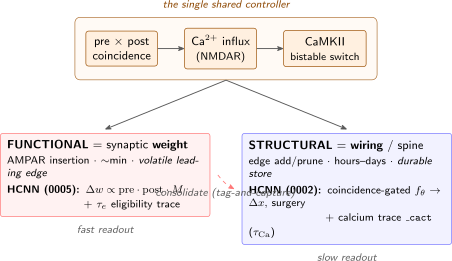
There is a deeper reason structure and function belong in the same paper. The modern consensus is not two plasticity systems but one upstream controller — postsynaptic calcium decoded by CaMKII — with two readouts on a timescale ladder.[11][12] The synaptic weight is the volatile leading edge (AMPARs turn over in ~30 minutes); the wiring is the durable store (spine volume is stable for months). Weight change leads at induction; sustained activity consolidates it into structure.
HCNN now realises both readouts, gated by the same local coincidence signal. The functional readout is v0.4's three-factor rule with its slow eligibility trace; the structural readout is this paper's coincidence-gated with its calcium trace. They are still separate mechanisms in the code — unifying them under a single calcium controller is the v0.5 step — but the correspondence is exact, and it is what makes "the layout is the memory" (next section) the structural counterpart of a synaptic reward-prediction error.
Crucially, gating did not break the locality firewall. The coincidence feature is strictly local — each cell reads only its own calcium and that of its in-radius neighbours — and it is distilled into alongside the displacement and the surgery decision, so the runtime chassis still reads no global quantity.
The layout is the memory
If structure is the durable store, it should hold a memory — and one that lives in the wiring, not in the weights and not in the dynamics. The gated rule lets us test this directly, with the cleanest design the question allows: a causal double dissociation.
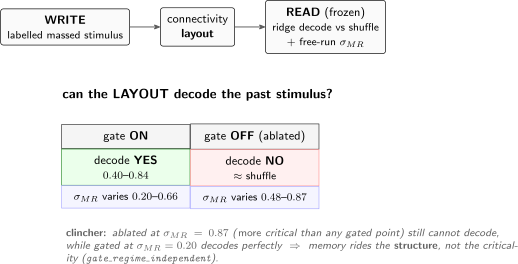
The protocol is write-then-read. In the write phase, a labelled stimulus is delivered as massed repetition, and the coincidence gate is free to remodel the graph. Then structure is frozen and the network runs free; in the read phase we ask a ridge decoder, against a shuffle null, whether the connectivity layout alone — degree, local geometry, no activity history — recovers which stimulus was written.
Arm one isolates the gate. With the gate on, the layout decodes the past label well above shuffle (0.40–0.84 across sizes, scaling with the per-node add budget); with the gate ablated, it does not (decode collapses to the shuffle floor) — while avalanche criticality survives both (crackling true, finite branching ratio). So the structural memory is the gate's doing, not a by-product of being critical.
Arm two isolates criticality. Sweeping the drive moves over a 3.3× range, and the gated decode is invariant across it — byte-identical at 0.80 from to . The clincher closes the confound that the two arms are not σ-matched: an ablated network driven all the way to — more critical than any gated point — still cannot decode, while a gated network at decodes perfectly. Memory tracks the gate, not the operating point.
Two consequences matter for the larger programme. First, this is "the layout is the memory" made literal: a stimulus survives in the graph, dissociated from both the weights and the dynamical regime — the structural counterpart of a synaptic memory trace, and exactly what the durable-store readout predicts.[13] Second, it dissolves a small- tension. At side 6 the gated substrate plateaued sub-critical when forced to also carry memory — the memory↔criticality Pareto front of a tiny network. Scaling lifts it: at side 8 the gated, memory-bearing structure reaches — the reverberating regime measured in vivo — while decoding at 0.84.[14] The honest negatives remain (the idle net is still volume-law and not off-equilibrium; raising the rate set-point, not adding short-term depression, is what reaches the reverberating point), and they are taken up in the verdict — but the central claim stands: a purely local, activity-gated wiring rule grows a structure that remembers.
Scale — law or fit?
A rule that only works at its training size has solved an instance, not found a law. The gate is scale: hold the intensive surface metric — surface removed per free node, fractional descent — flat as the cube side grows, a finite-size-scaling read with a flat asymptote, and re-distil at growing to see whether it converges to a fixed point. Because is purely geometric, a geometry-only run mode drops the spiking dynamics and runs the structural rule alone, reaching on a single box.
The first scale step, side 5 to side 8, says three things — one expected, one better than expected, and one that explains the second.
First, both emergent properties transfer. The same calibrated operating point
gives at side 5 and at side 8 — the quasi-critical
branching ratio is intensive, as an operating point should be. And NG-emergence holds
at scale: the per-node backtracking gate is scale-independent, so the side-8 chassis
descends exactly monotonically (frac_descending , surface removed ),
even cleaner than side 5's .
Second, the geometry differentiates the branching ratio at scale. At side 5 all three arms — rule, watcher, frozen-geometry null — read ; they split only at side 8, where the rule holds and the watcher while the frozen null falls to . The rule's grown geometry reads more critical than the static lattice. Why it does is where we had to be careful, because the obvious story does not survive its controls.
Third — the tempting mechanism, "the rule grows a small-world graph that drives the
criticality," is confounded. The rule's graph is small-world (clustering
, short paths, climbing across scale). But
two controls (topology_causal_v02.py, side 8) take the causal chain apart:
- The small-world is from the rewire, not Nambu–Goto. Run the proximity rewire on a static lattice with migration off and it is already small-world (, matching the full rule's ); run migration with no rewire and . A connect-what's-near rule clusters by construction; that is the source. NG-migration's distinct, measured contribution is long-range bridges: the fraction of edges spanning far in the original lattice rises from (rewire-only) to (full rule). NG adds reach, not small-worldness, and is not necessary for it.
- Criticality is structural, but not specifically small-world. Randomising the rule's graph at fixed degree (degree-preserving swaps) moves only from to a peak of , and a fully random short-path graph reaches the same value. Short paths matter a little; small-world structure as such is not privileged. What the control does establish cleanly is a negative: the lift is a genuine path-length effect at fixed degree, not a density artifact.
So the honest statement is narrower than the slogan. The rule grows a quasi-critical graph; the graph is small-world because the rewire is; and the criticality is structural (short paths) but not small-world-specific. The surface objective's own causal role in the criticality is not established by these controls, and the paper does not claim it.
One honest complication surfaced here, and it is a property of the measurement, not
the rule. Avalanche-applicability is extensive. At 512 neurons the population is
never silent (frac_empty ), so avalanches cannot be separated and the
power-law/crackling battery returns — inapplicable. A single per-cell
operating point cannot preserve population silence across , since total activity
scales as . The branching ratio is therefore
the scale-invariant criticality readout; the avalanche battery needs a size-aware fix
(finer binning, or fixed-size subsampling after Priesemann), not a per-size
recalibration.
Holography — does the geometry carry information?
The rule earns the NG geometry. The question for everything downstream — a holographic code, the eventual FEP layer — is whether that geometry carries information on its boundary. The cheap, falsifiable version (a feasibility gate, not a demonstration): for bipartitions of the blob, does the cross-cut mutual information track the Nambu–Goto surface area of the cut (the tube-wall area of the links it severs) or the volume (node count) of the smaller side? Area-law is the precondition a holographic code needs; volume-law or flat fails the gate early, on a prototype, before the expensive layers assume it holds.
We swept planar slabs and concentric shells — geometries where area () and volume () disagree — and regressed cross-cut MI against each, per arm.
The result is a soft negative. At side 5 and side 8, every arm — rule, watcher, frozen null — reads volume-law: MI tracks the node count, not the surface area (side 8 rule: volume vs area ; the frozen null is pure volume, area ). A companion geometric probe agrees — the grown graph is a clustered small-world, not strongly hyperbolic (Gromov for all arms, where a tree is and a flat space ), so the bulk is not the AdS-like geometry a holographic code would want.
Two caveats kept this a soft negative rather than a verdict, and we have now closed both. Scale: at 512 nodes the cut surface and the enclosed volume are still correlated; the discriminating test wants side 16 and up — the scale 0003 buys, and at scale the verdict held (volume-law from to ). Estimator: a Gaussian MI from the activity covariance scales almost mechanically with a region's dimensionality, so it is plausibly biased toward volume-law; a dimensionality-robust estimator was needed before the verdict could be trusted.
Chasing the estimator caveat is where the story turned, twice. We first swapped in two dimensionality-robust estimators — a matrix-based Rényi- MI and a -nearest- neighbour (KSG) MI — on a clean toroidal (3-torus) boundary, where every cut is internal and no open face contaminates a region's surface. They flipped the verdict to area-law. That looked like the door opening — until we did the control that should have come first. We built synthetic rasters with known ground truth (independent noise; an engineered volume-law state; a rank-one global state) and ran them through the same pipeline. The controls were damning: on a state that is volume-law by construction, the Rényi and KSG estimators both report area-law. Their MI collapses into a narrow band, near-identical for independent noise and for genuine volume-law — they are not dimensionality-robust here, they are insensitive. The "area-law" was the estimator failing, not the substrate encoding. Only one estimator passed all three controls: the Gaussian MI with a shuffle- null correction (subtract the MI of time-permuted data, which removes the finite-sample dimensionality bias). Read with that validated estimator, the clean toroidal boundary is volume-law at side 16 (), and it survives the null correction — so the volume-law is genuine, not the covariance bias. A companion correlation probe finds spike correlations that are weakly power-law rather than exponential, but the exponent drifts with system size and the fit degrades, so it is not yet a stable conformal exponent — suggestive, not a critical signature.
So the verdict firms up rather than reverses: the celebrate-early area-law did not fire, and — read honestly, with an estimator that can tell area from volume — the idle boundary is volume-law. But the reading of that negative has changed. A driven, dissipative, quasi-critical spiking net at rest is thermal-like (an ETH default), and volume-law is exactly what such a state should show — area-law is the property of ground states of gapped local systems and of conformal critical states, not of an idle blob. Volume-law-at- rest is therefore the expected default, not a refutation. Area-law would require a special dynamical phase — genuine criticality plus long-range/conformal correlations — and plausibly a boundary that is encoding structured input under an FEP loop. The informative version of the holography question is thus not about the geometry at all; it is whether the boundary's dynamical phase, eventually under an encoding task, can reach an area-law regime. That is a v0.4 question, and we now know to ask it with a controls-validated estimator — the lesson the whole detour bought.
Verdict
Against the two goals it set itself — frozen rule , watcher off — the chassis earns the following.
| goal | side 5 | side 8 | status |
|---|---|---|---|
NG emerges (surface removed , frac_descending ) |
removed ( watcher ), frac |
removed , frac (exactly monotone) |
met at both scales (from oscillating) |
| quasi-criticality () | met — transfers across scale | ||
| geometry ties to criticality | rule watcher null | rule / watcher vs null | observed at scale; causal attribution confounded |
The headline, all from measured runs: a purely local, distilled rule produces emergent surface minimisation and emergent quasi-criticality with no global term at runtime, and at scale its grown geometry reads more critical than the static lattice — freeze the geometry and falls to while the rule holds . What the geometry differentiation is not is the tidy "NG grows a small-world graph that drives criticality" story: the controls (see Scale) show the small-world comes from the proximity rewire, not the surface objective, and that the dependence on topology at fixed degree is real but small and not small-world-specific. The clean claim is the careful one.
What's resolved, and what's left:
- Goal 1 at scale — done. The local-backtracking gate is scale-independent:
frac_descendingat side 5, at side 8. The oscillation is closed. - The avalanche battery at scale — done. Fixed-size subsampling restores population silence at 512 neurons, so the power-law/crackling legs corroborate at scale.
- Tier-5 — the causal chain is confounded, and the controls say so. "NG small-world criticality" overclaims: the small-world is a property of the rewire construction (a static-lattice rewire is already small-world), and is a path-length effect at fixed degree that a random graph reaches too. NG-migration's distinct, measured role is long-range bridges. The shortcut budget remains a real engineering lever (it lifts side-8 to ), but the surface objective's specific causal role in the criticality is not established, and we do not claim it.
- The criticality is tuned, not self-organised — and a dynamic-synapse upgrade did not change that. sits near because the drive is calibrated to put it there; the distance to criticality moves with the input strength. The principled route to drive-independent (self-organised quasi-critical) behaviour is dynamic depressing synapses — the resource that depletes on use and recovers slowly (Levina–Herrmann–Geisel). We switched them on and swept their parameters () across a drive decade. No regime delivered it: the avalanche statistics are ill-posed at every point, and the only arm with a flat is the homeostat-off arm collapsing onto the degenerate synchronised fixed point, not a critical one. So criticality here remains a tuned operating point. (A caveat in the other direction: short-term depression also breaks the avalanche framework's well-posedness, so this is partly "no self-organisation" and partly "the probe cannot resolve it under depression" — both readings withhold the self-organised-criticality claim.)
- The structural dynamics were a seizure — and fixing them earns a memory. A second pass audited not whether structure descends but how it moves, and found the inherited teacher remodelled add-only, globally, on the activity timescale — a seizure that violates the slow-drive/fast-relaxation axiom. Per-neuron desynchronised retiming plus a local calcium-coincidence gate with balanced turnover restores breathing structure (the timescale ratio lifts from to – while rises), and the gate is distilled into so locality holds. The fix earns a positive result the static rule could not: a causal double dissociation in which the connectivity layout alone decodes a past stimulus, following the gate rather than the operating point (decode invariant across a 3.3× sweep; an ablated net at still cannot decode, a gated one at can), with the memory-bearing structure reaching the in-vivo reverberating regime () at side 8 while decoding. The honest negatives stay attached: the gate is a clean null on FEP-readiness (it neither breaks nor solves the stimulus-memory gap vs a geometric control); short-term depression drove down at sparse (raising the rate set-point was the working lever); and the idle substrate stays volume-law and off-equilibrium-dead, with the area-law and aliveness questions facing a regime tension (aliveness wants near-critical, an MI area law wants finite correlation length — they may not co-occur).
The hand-off is unchanged in shape but stronger in content: the same chassis — frozen local rule, no global term, now retimed and coincidence-gated — scaled and ported to async event-driven execution is v0.2 (0003). Because that base substrate changed, 0003 re-runs its ladder on the re-distilled rule (the scale-invariance descent, the structural decode at -independent features and a mass-conserved engram budget, the ladder via the drive lever, and FEP-readiness with a real input fan-out). Criticality is no longer the deferred success criterion it was at v0.1; it already emerges here (tuned, per point 4). What 0003 must show is that it survives asynchrony at scale — and the scale it buys is what let a follow-up actually pin the two questions this prototype left open. The geometry-to-criticality attribution stays confounded. The holographic precondition resolved the other way: read with a controls-validated estimator (Gaussian MI with a shuffle-null; the dimensionality-robust Rényi/KSG estimators fail a known-volume-law control), a clean toroidal boundary is volume-law through scale — genuinely, not as a covariance artefact. That is the expected thermal default of an idle quasi-critical net, so it closes the idle-substrate version of the question and moves the live one to the dynamical phase under an encoding (FEP) task — a v0.4 question, now to be asked with the validated estimator.